
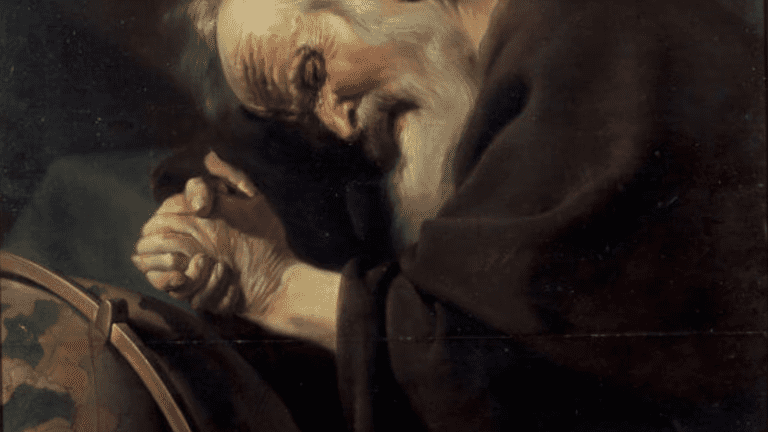
Heraclitus' wisdom: War as the origin of all things
|

Heraclitus' wisdom: War as the origin of all things

Heraclitus, a pre-Socratic philosopher, once coined the idea that war is the father of all things. With the numerous armed conflicts raging around the world and causing untold suffering, this statement sounds provocative or at least incomprehensible. This statement, which is often quoted and discussed, offers a deep insight into the dynamic nature of existence. But in order to...

Why philosophers are not always smart: Intelligence is relative

Why philosophers are not always smart: Intelligence is relative

I would venture the following assertion: even great philosophers can be stupid. No, even more: they are stupid. Stupid and intelligent at the same time. Just as each of us is stupid and intelligent at the same time. Note: I do not want to use the word "stupid" here in an offensive or strong sense. I am merely using it in this context to emphasize the...

Descartes' "Cogito, ergo sum" becomes "Ego sum, ego existo"
|

Descartes' "Cogito, ergo sum" becomes "Ego sum, ego existo"

Let's take a look at Descartes' probably best-known concept, which still resonates today and is often regarded as the essential basis of epistemology: "COGITO ERGO SUM." "I think, therefore I am." René Descartes He established this insight as the first foundation of his philosophy, because at its core, "Cogito, ergo sum" serves as the fundamental truth in Descartes'...

The difference between "a priori" and "axiom" explained

The difference between "a priori" and "axiom" explained

The terms "a priori" and "axiom" are both important in philosophy and logic, but they stand for different concepts: A Priori The term "a priori" refers to knowledge or justifications that are independent of experience. "A priori" knowledge is based on logical conclusions and not on empirical evidence. In contrast, the "a...

Alan Watts, Schopenhauer and the universe that experiences itself
|

Alan Watts, Schopenhauer and the universe that experiences itself

Alan Watts is known for his interpretation and integration of Eastern philosophies into Western thought. A good example of this is the following view, which is strongly influenced by Eastern thought, particularly Buddhism, and, interestingly, has certain similarities with Schopenhauer's philosophy despite the different contexts and conclusions. "Through our eyes, the universe is perceiving itself. Through...

Schopenhauer and Kant: Consciousness and Being

Schopenhauer and Kant: Consciousness and Being

Philosophical discourse on the nature of reality, consciousness and being has long been a complex and nuanced field. Two prominent figures in this field, Arthur Schopenhauer and Immanuel Kant, offer profound insights that are both in agreement, or at least convergent, and different in interesting ways. At the center of their philosophies is the...

Descartes on the separation of body and mind

Descartes on the separation of body and mind

The mechanistic view of the universe assumes that the body, which is influenced and controlled by physical laws, and the ethereal world of thought and consciousness are separate. You may have wondered about the complicated relationship between your mind and your body. Philosophers have been puzzling over this for thousands of years. One...

Descartes on mechanicism
|

Descartes on mechanicism

By redefining thinking about the nature of the universe, Descartes revolutionized not only the world of philosophy, but the entire world. Previously, Aristotelian physics had been the dominant worldview of the Western world, which, simply summarized, presupposed a universe full of purposes and inherent qualities. Everything had a fixed purpose that it followed or goals after...