

Alan Watts on Problems of Modernity: Philosophers and Materialism
| |

Alan Watts on Problems of Modernity: Philosophers and Materialism

Alan Watts was known for placing criticism on various circumstances of our society. This article is about Watts' view that our perception of materialism is wrong and modern philosophers have forgotten an important aspect of philosophy. Alan Watts made it clear that in his opinion the term materialism would be misinterpreted. Actual materialism implies...

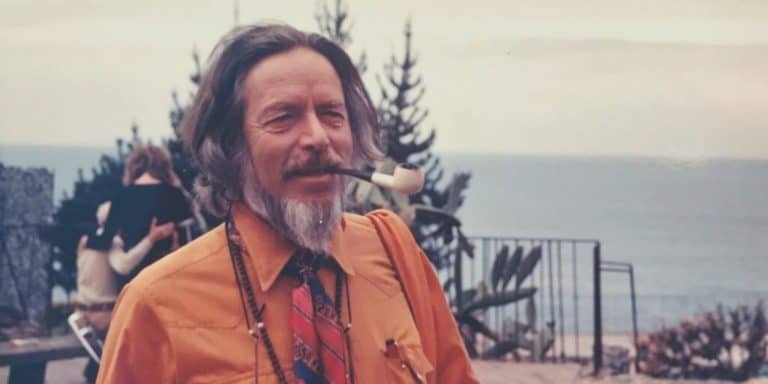
Alan Watts reveals the secret of Nirvana
|

Alan Watts reveals the secret of Nirvana

Alan Watts (born 1915 in Chislehurst, Great Britain, died 1973, Druid Heights, USA) first studied theology and later moved to the United States (1938) and began Zen training. From then on he began to study Eastern philosophy in general. Therefore, it is not surprising that the Buddhist concept of nirvana became part of his writings....

Alan Watts on the futility of life (and Wu-Wei)
|

Alan Watts on the futility of life (and Wu-Wei)

English philosopher Alan Watts is known for "translating" Indian, Japanese and Chinese traditions of Buddhist, Taoist and Hindu philosophy for a Western audience. In his writings and lectures, he often tried to convey the meaning of foreign words and concepts. One of these is the Taoist "Wu-Wei." Wu-Wei describes the art of non-striving, which is probably...

Quotes explained: Stephen Covey on our perception of the world
|

Quotes explained: Stephen Covey on our perception of the world

We often forget that our perception of the world is not truly objective, but is largely influenced by who we are. The quote comes from the French writer Anaïs Nin, but has become even more famous thanks to the American bestselling author Stephen Covey, who has included it in several of his works (e.g. ....).

You carry the history of mankind within you

You carry the history of mankind within you

What if we carry around not only our own history, but also that of our ancestors, which on top of that influences us in everyday life? What sounds like an idea from the famous Assassins Creed series of books and games is actually an integral part of Carl Gustav Jung's theory of analytical psychology. Even the name of the super-computer "Animus" finds...

Musashi's Most Relevant Quotes For Modern Life
| |

Musashi's Most Relevant Quotes For Modern Life

In this article, we'll look at six of Miyamoto Musashi's greatest quotes that have been extremely helpful to me (and countless other people) to steadily improve, see things in a more relaxed way, and find more inner peace - in short, to better cope with modern life. In this article we will look at the meanings and...

Why we want to change the world, but not ourselves
| |

Why we want to change the world, but not ourselves

Most great ambitions are those through which our environment is to be influenced. A coincidence? Not at all. There are various reasons why we are so averse to changing ourselves, but we work with a naturalness to change our environment. History has produced several great thinkers. A special spirit of modernity was Leo Tolstoy,...

Carl Jung declares : "I would rather be whole than good!"
|

Carl Jung declares : "I would rather be whole than good!"

What may seem simply provocative at the outset is, on closer examination, a well-considered statement and is in itself the concentrate of Carl Gustav Jung's convictions. But why is this so and what exactly is meant by this statement, which shakes the value framework of our society? Jung (1875 - 1961) is still regarded today as one of the...

Miyamoto Musashi and life without preferences
| |

Miyamoto Musashi and life without preferences

Miyamoto Musashi, the sword master and founder of the school "of the two heavens" (jap. 二天一流, Niten Ichiryū), stated in his writings in various places that it is crucial not to have preferences. Only in this way, he said, could one succeed in battle. An example of this is the following quote from the Gorin-No-Sho (The Book of Five Rings):...